When Hungarians went to the polls last month to defeat the authoritarian Prime Minister Viktor Orbán, they did so in record numbers. A historic 77.8 percent of voters cast ballots—Hungary’s highest turnout ever.
The last time U.S. voter turnout came close to that level was in 1900 (73.2 percent), when William McKinley beat Williams Jennings Bryan. Since then, presidential elections have typically turned out fewer than two-thirds of voting-age Americans (in the 1980s and ‘90s, it was closer to half). Even in 2024—which had the highest turnout since 1968—just 64.7 percent of Americans voted.
Americans take for granted their right to vote—which is why it’s in such jeopardy today.
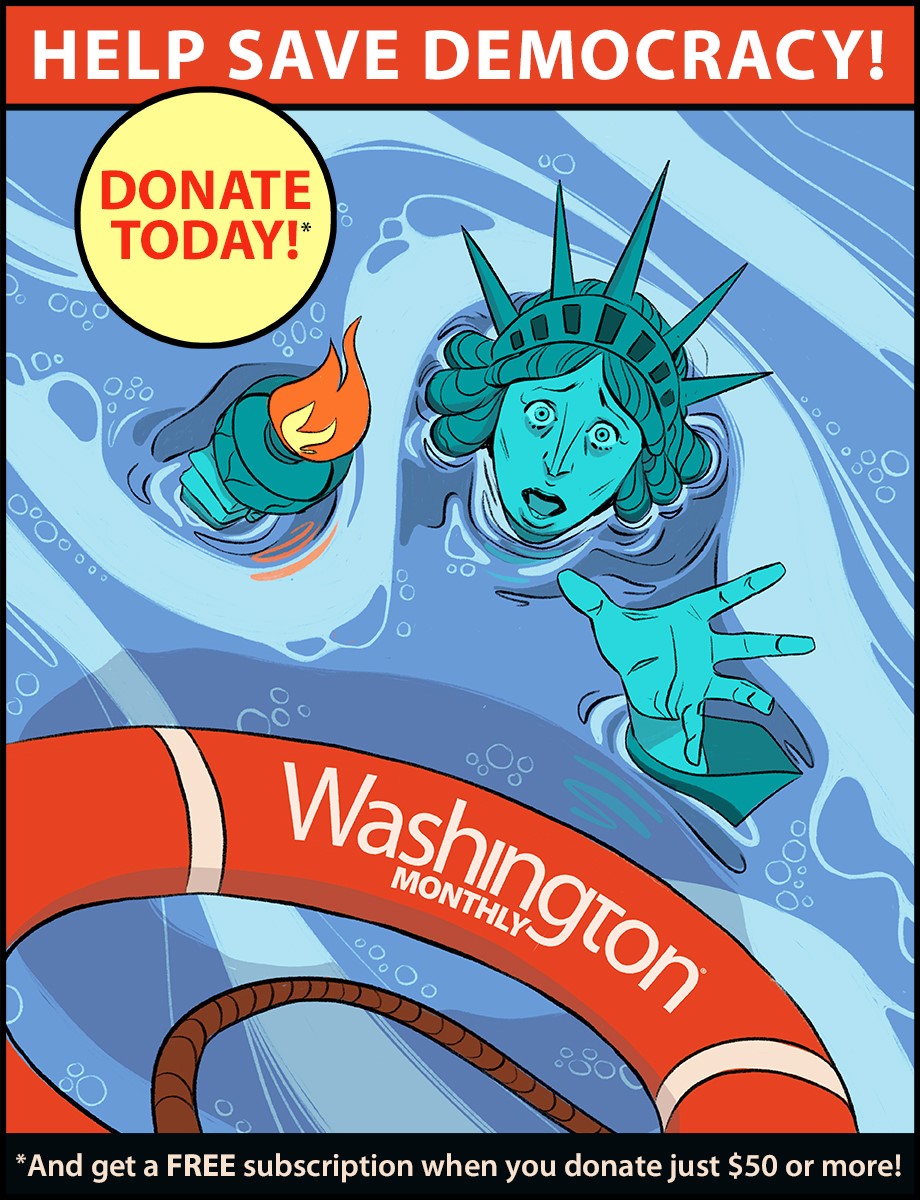
At the risk of sounding alarmist, America may have had its last free and fair election in 2024. The Trump administration, together with its Republican allies and conservatives on the Supreme Court, have systematically—and successfully—waged a campaign to disenfranchise large swathes of U.S. voters. America is collapsing toward “competitive authoritarianism”—“electoral competition that is real but unfair,” in the words of democracy scholars Steven Levitsky and Lucan Way.
Racist redistricting. Millions of Black Americans could soon lose their voice in Congress, thanks to the Supreme Court. Last week, the Court gutted the Voting Rights Act, ruling that a majority-Black congressional district in Louisiana was “an unconstitutional racial gerrymander.” This week, the Supreme Court expedited the effective date of its decision—thereby clearing the way for Louisiana to redraw its districts in time for the midterms. Republican Governor Jeff Landry has suspended the primaries, even though 42,000 Louisianans had already cast their ballots.
As many as 19 majority-minority districts could eventually be drawn out of existence, according to the civil rights group Fair Fights Action. On Thursday, Tennessee unveiled a new map that carves up majority-Black Memphis and would likely eliminate its sole majority-minority district. “Not since Jim Crow have we seen this level of systematic disenfranchisement of Black voters,” said Congressional Black Caucus Chair Yvette Clark in a statement.
Burdensome ID requirements. Trump has demanded federal legislation requiring documentary proof of citizenship to register to vote—though noncitizen voting is practically nonexistent. The so-called “SAVE Act” has yet to pass Congress, but some states are moving forward with their own versions. Last month, Florida Gov. Ron DeSantis signed the Florida SAVES Act, which requires proof of citizenship and limits the kind of ID that voters can present at the polls (student IDs, for example, would no longer be accepted). Indiana, Kentucky, Montana, Tennessee, Utah and West Virginia have also passed harsher voter ID laws. The Brennan Center for Justice estimates that as many as 21 million Americans lack ready access to a birth certificate or passport, which this type of legislation typically requires. Many married women may also find themselves disenfranchised if their birth certificates don’t match their married names.
Limits on vote by mail. Trump is also trying to limit access to vote by mail—which nearly one in three voters relied on in 2024 to cast their ballots. In an executive order issued in March, Trump decreed that all mail-in ballots must be handled by the U.S. Postal Service, and that only voters on federally approved “state citizenship lists” would be allowed to vote. The National Rural Letter Carriers Association warned that rural voters could be especially burdened. “Any policy that creates confusion, delays, or places barriers in the handling of election mail will fall hardest on those voters who already face the greatest obstacles to accessing in-person voting,” the association said in a statement.
Trump’s attempt to limit vote by mail is likely unlawful. The U.S. Constitution reserves to states the power to govern the “Times, Places, and Manner of holding Elections for Senators and Representatives,” and his executive order has already drawn legal challenges. Proof of citizenship requirements are also more likely to disadvantage Republicans, according to the Bipartisan Policy Center (Democrats are more likely to have passports), which means the SAVE Act won’t deliver the partisan benefits Trump assumes it will deliver.
Yet these are small consolations in comparison to the damage that Trump and the GOP have already done, both to Americans’ right to vote but also to their faith in U.S. elections. According to a March PBS News/NPR/Marist survey, more than a third of Americans are “not very confident” or “not at all confident” that their local elections will be fair this fall.
There’s only one solution. Americans must take their cues from the Hungarians. They must vote.
New at the Monthly…
Don’t despair for Pax Americana. In less than a year, Trump has managed to rip up the international alliances that have ensured relative global stability for the last 80 years. But Monthly Editor in Chief Paul Glastris argues that it’s far too early to write the epitaph for a U.S.-led global order. “The same power that makes America capable of doing vast damage also enables it to do great good,” Paul writes in his Editor’s Note for the latest print issue of the Monthly. “The world understands that.” Read here.
And here’s the spring issue, featuring some of our favorite pieces from the last few months:

Too comfortably numb. Many Americans have not only become inured to the idea of political violence—they now welcome it. More than 80 percent of MAGA voters in a new University of California-Davis survey “said the American way of life was disappearing so fast that force may be required to save it,” writes contributing writer Rob Shapiro. Worse, 11 percent said they would personally be willing to use violence against government officials to achieve their aims. But Democrats aren’t exactly all that dovish either; surveys show that they too are becoming more tolerant of political violence. Read here.
College cost confusion. Last week, we reported on an effort by colleges to water down legislation requiring more transparency in tuition pricing and financial aid. That’s a decision colleges may come to regret—new polling from Strada Education shows that a root cause of public anger at higher education is the lack of clarity and simplicity in college financial aid offers. “This confusion about college costs and financial aid appears to be breeding public mistrust about the main interests that motivate institutions,” writes former University of Kentucky provost Michael Nietzel. Many Americans in the Strada survey said they thought colleges cared more about making money than educating students. Read here.
Plus…
- Politics Editor Bill Scher argues that Democrats should stop antagonizing Senator John Fetterman—lest they risk turning his flirtation with the GOP into an elopement. He also warns against turning Democratic primaries into referendums on Middle East policy. Democrats don’t need to preemptively tear themselves apart, he says.
- The Progressive Policy Institute’s Bruno Manno writes about the Trump administration’s plans to remake the college accreditation process—which sounds obscure but could have profound impacts on higher education.
- Contributing writer Jon Alter marvels at the spinelessness of Trump’s latest crop of judicial nominees, all of whom are “staying silent” on the question of whether Trump is constitutionally eligible for a third term (for the record, the answer is “NO.”).
- Contributing writer James Zirin praises King Charles’s recent visit to America.
- Ukraine-based journalist Tamar Jacoby asks if Europe can step up to save Ukraine—since America is not.
- Health policy expert Merrill Goozner bemoans a new “gold standard” for science at the CDC—which has led to the suppression of evidence on vaccine efficacy.
Coda (unaffordability edition)…
While the U.S. stock market continues to defy gravity, low-income families are sliding toward rock bottom. Such is the nature of the Trump economy, and the impact of Trump’s policies on the households least equipped to weather the turmoil he’s unleashed.
This week, the Federal Reserve Bank of New York released a study showing the disproportionate impact of higher gas prices on low-income households. While all households are spending more to fill their tanks, researchers found a “K-shaped” pattern in gas consumption, depending on household income. In March 2026, after the initial shock in prices, households earning less than $40,000 cut back their gas consumption by 7 percent—while still spending 12 percent more. Meanwhile, households earning $125,000 or more spent 19 percent more on gas that month—though consumption fell just one percent.
Further hardships are in store for poor Americans when the policy changes included in the “One Big Beautiful Bill” passed last summer start taking effect. Nebrasksa, for instance, is rolling out Medicaid work requirements eight months early, and experts expect that thousands will lose coverage. As many as 4.3 million Americans are no longer receiving food assistance—also likely the result of tougher work requirements included in the OBBB. In addition, Republicans’ refusal to extend tax subsidies for Obamacare have pushed 1.2 million Americans off coverage so far.
For many Americans, “affordability” is an aspiration. “Survival” is the new imperative.
As always, thanks for reading. And please share your thoughts! We want to know what you like, don’t like, and what we can do better.
Have a great week!
Anne Kim, Senior Editor