In the summer of 1989, I became an assistant editor at The National Interest, a small journal founded in 1985 by Irving Kristol. Kristol, known as the godfather of neoconservatism, had tapped a former Australian diplomat and academic named Owen Harries to serve as its editor. The magazine had not made much of a mark, mostly running a spate of essays about the urgency of confronting communism. But the unexpected tumult in the Soviet empire changed that. When I came on board, Harries showed me a lengthy manuscript on political philosophy and foreign affairs, written by a State Department official named Francis Fukuyama, that he was planning to run in the next issue. It was called “The End of History?”
The rest, as they say, was history. In his essay, Fukuyama created an international sensation by concluding that we might be on the verge of “the end point of mankind’s ideological evolution and the universalization of Western liberal democracy as the final form of human government.” In October, a month before the fall of the Berlin Wall, the writer James Atlas penned an essay in The New York Times Magazine titled “What Is Fukuyama Saying? And to Whom Is He Saying It?” When I went to deliver extra copies of The National Interest to a newsstand located on Farragut Square, the owner exclaimed that the issue was outselling even the pornography.
In anointing liberal capitalism as the wave of the future, Fukuyama, more than anyone else, established the intellectual foundation for a younger generation of neoconservatives. Led by Irving’s son, the former Weekly Standard editor William Kristol, and Robert Kagan, then a speechwriter for Secretary of State George P. Shultz, they espoused a crusading foreign policy—one that culminated in the 2003 Iraq War, when the George W. Bush administration vowed an “end to evil.” Yet Fukuyama ended up severing ties with many of his neocon brethren over their unflinching support for the war in Iraq, which he saw as delusional. In repudiating his movement allies, Fukuyama looked like the outlier at the time. But since then, the neocons have split over the rise of Trump, as Kristol (now editor at large for the staunchly anti-Trump Bulwark), the foreign policy maven Kagan, and others have rightly denounced the president as a menace to American democracy. Another faction includes figures such as Elliott Abrams, who criticized Trump when he ran for the presidency in 2016 but quickly became MAGA-friendly after the real estate mogul defeated Hillary Clinton. This faction came to see Trump as a good thing: a staunch supporter of Israel and its hardline Prime Minister Benjamin Netanyahu. What explains Fukuyama’s percipience about the dangerous road that the political right was traveling down?
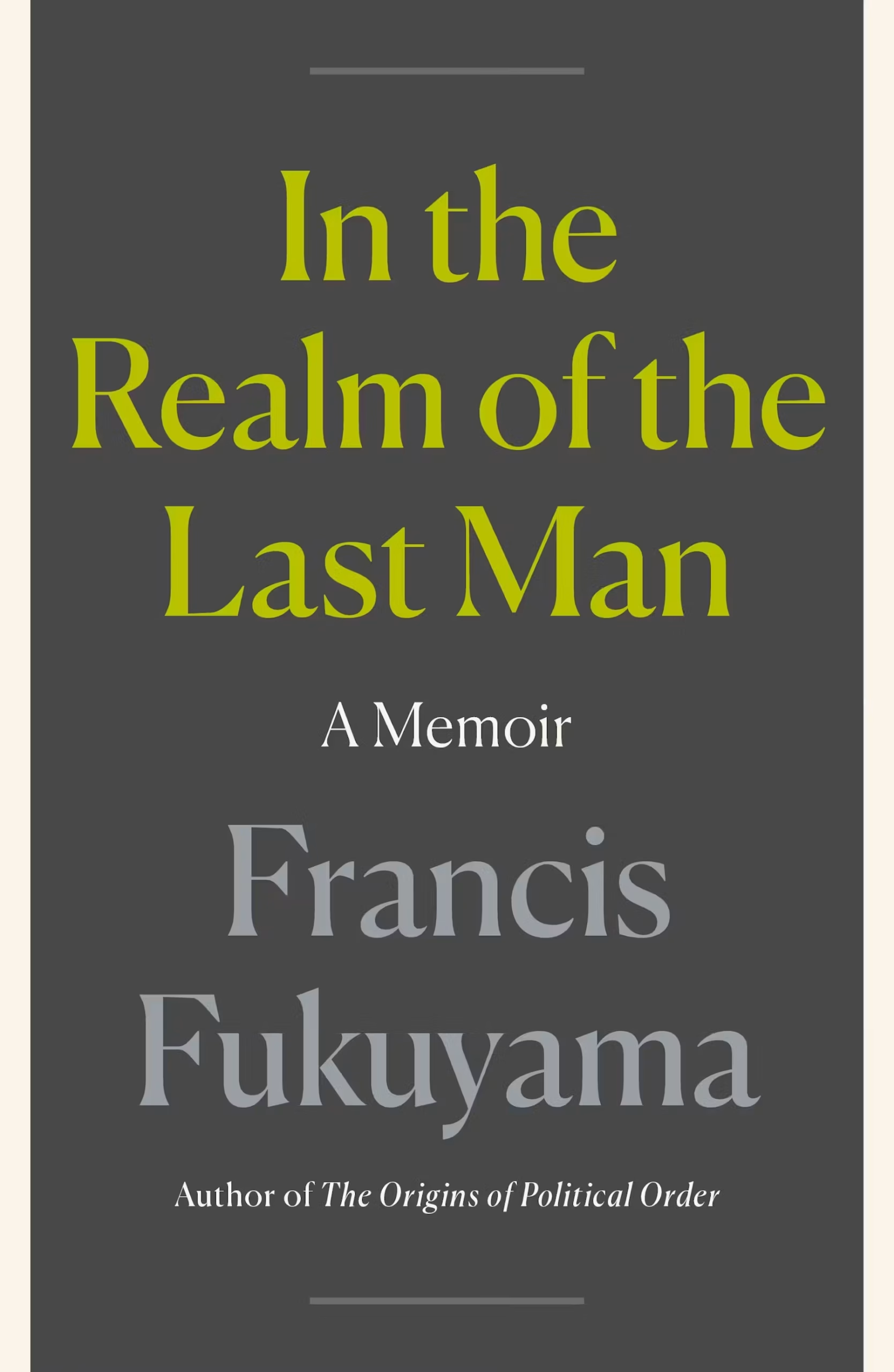
by Francis Fukuyama. Farrar, Straus
and Giroux, 304 pp.
In his new autobiography, In the Realm of the Last Man, Fukuyama traces his intellectual odyssey. Written in a cool, dispassionate, and self-critical tone, Fukuyama’s memoir contains deft portraits of his teachers, such as Allan Bloom, author of the best-selling The Closing of the American Mind. It goes on to recount his mounting unease with the political right and the rise of Donald Trump. His memoir makes clear that he always harbored an independent streak that was rooted in a penchant for questioning conventional wisdom. In the 1970s, this manifested itself by attacking the liberal left for what Fukuyama saw as its illusions about Soviet totalitarianism. But as the neocon movement, which became obsessed with waging the culture war in the 1990s, curdled into its own set of dogmas, he lost his faith in it. The Iraq War merely delivered the final blow to his illusions about the right.
There is, of course, an irony in Fukuyama’s earnest defenses of liberal democracy, because he originally prognosticated that it was on an unstoppable roll. But he does not believe that the rise of illiberal authoritarians such as Trump or Viktor Orbán dispels his original end of history thesis. While they do threaten Western democracies, neither China nor Russia can be said to pose an ideological challenge to the United States. Instead, they are exploiting the internal fissures in Western societies, which is why he maintains that the real danger comes from within. In this regard, he does not hesitate to point the finger at intellectuals such as Michael Anton, the former State Department official and author of the famous “Flight 93 Election” pro-Trump manifesto, who have endorsed Trump as a convenient battering ram to deploy against the liberal left.
One reason that Fukuyama may have harbored a more independent outlook than many on the right is that his family witnessed the dark side of American democracy during World War II, when several relatives were incarcerated with about 120,000 other Japanese Americans in barbed-wire camps. Fukuyama reports that his father, Yoshio, avoided internment by obtaining a scholarship to Doane College in Crete, Nebraska. “I will be eternally grateful,” he writes, “to these small liberal arts colleges that reached out to help Japanese American internees in this period, and would make similar gestures to Arab Americans after September 11.” Fukuyama, who was born in 1952, grew up in a housing development in Manhattan, where his father worked for the national board of the United Church of Christ. In the 1960s, Yoshio became a prominent civil rights activist and opponent of the Vietnam War.
In what appears to be something of an Oedipal rebellion, Francis bridled at his father’s crusading liberalism, confessing that he could make “snide remarks” to him. At Cornell University, where Fukuyama enrolled in 1970, he came under the spell of Bloom and the Straussian crowd. A flamboyant professor who wore double-breasted Savile Row suits, Bloom emphasized the need for a return to the virtue of the ancients. In his roman à clef, Ravelstein, Saul Bellow depicted him as a mesmerizing figure. “All these students I’ve trained in the last thirty years still turn to me,” the professor Abe Ravelstein observes, “and in a way the telephone makes possible an ongoing seminar in which the policy questions they deal with in day-to-day Washington are aligned with the Plato they studied two or three decades ago, or Locke, or Rousseau, or even Nietzsche.”
The Straussians are disciples of Leo Strauss, the German refugee and political philosophy scholar who taught at the University of Chicago. Strauss had witnessed the collapse of liberal democracy in Weimar Germany and the rise of Nazism. He warned about the flaccidity of modern liberalism, one steeped in a nihilistic relativism that repudiated objective moral truths. He condemned modern social science for its “value neutralism” and, like Bloom, called for a return to classical political thought. Only a rediscovery of the wisdom of the ancients could rescue the West, which faced a new and dire ideological challenge from the Soviet Union after 1945. In his “The End of History?” essay, which was originally a lecture for a conference on “The Decline of the West” held by his former mentor Bloom at the University of Chicago, Fukuyama discussed Strauss at length. Fukuyama writes now that Strauss was “one of the most important intellectual influences in my life, despite the fact that I never met him.”
After a brief dalliance with postmodernist theory in Paris, Fukuyama concluded, very much in the Straussian vein, that “post-structuralism and deconstructionism were essentially nihilistic projects built on assertions of the impossibility of reasoned discourse, inference from empirical evidence, and ultimately of philosophy itself.” Fukuyama returned to America and entered graduate school at Harvard, where he studied international relations. Washington’s neocon milieu, with its Straussian dream of serving as an adviser to the prince, always beckoned. According to Fukuyama, “I fell in with a group of hawkish policy advocates, mostly Democrats close to Washington Senator Henry ‘Scoop’ Jackson, including his longtime aide Richard Perle.” The term “fell in” implies a certain passivity to Fukuyama’s association with the neocons, but it accords with his overall lack of ideological zeal. Fukuyama’s most important ally was the fellow Cornell graduate and Bloom student Paul D. Wolfowitz, who was serving as deputy director of the U.S. Arms Control and Disarmament Agency. Wolfowitz, who hired Fukuyama to work in the Reagan administration in 1981, was a protégé of both Bloom and Albert Wohlstetter, a leading defense intellectual at the University of Chicago and a bon vivant. Fukuyama was impressed by him. “Wohlstetter, with his goatee and graying hair, was an unusual character in his own right,” Fukuyama writes, “who reminded me in certain ways of Bloom.”
So far, so good. Fukuyama was at the intellectual epicenter of the neocon movement. He had signed a letter disseminated by Kristol and Kagan’s Project for the New American Century to topple Iraqi dictator Saddam Hussein. It wasn’t until he had attended a 2004 gala dinner held by the American Enterprise Institute, where Vice President Dick Cheney bestowed the Irving Kristol Award on the Washington Post columnist Charles Krauthammer, that Fukuyama publicly voiced his dissent with the Iraq War.
The speeches prompted Fukuyama to issue a critique of Krauthammer and others that became his book America at the Crossroads. Fukuyama’s fundamental point was that the neocons had always objected to the Great Society and other liberal programs to improve the lives of the poor as utopian social engineering. He asked how they could now endorse it abroad. What stands out about Fukuyama’s criticisms of the war is that they were grounded in cool analysis rather than strident bombast. Fukuyama observes that he should have written such a critique much earlier. “The problem,” he says, “was psychological, and not a matter of policy judgment or moral disagreement. The issue was a mental block against taking a public stand against the views of longtime friends.”
Fukuyama was ostracized by many of his former colleagues as an apostate. Krauthammer promptly accused Fukuyama of anti-Semitism for opposing the war. In 2010, Fukuyama retreated from Washington to Stanford University, where he has devoted himself to writing ambitious books on public policy that attempt to diagnose and solve the ills of contemporary democracies. In his impressive two-volume political history, The Origins of Political Order and Political Order and Political Decay, he examined the rise of good governance and the cause of its decline. In his academic ambitions, Fukuyama is more akin to the first generation of neocons such as Daniel Bell and Nathan Glazer, both of whom were coeditors at The Public Interest and scholars, not polemicists, first.
It’s also the case that Fukuyama, in abandoning the right, foreshadowed the fracture that took place in modern conservatism. On one side, there were those who cleaved to Donald Trump; on the other, Never Trumpers such as Bill Kristol and the former Wall Street Journal editorial page writer Max Boot, both of whom have moved to the left on economic and social issues as well. According to Fukuyama, “Max, who had edited my op-eds for The Wall Street Journal, told me at one point that he was actually relieved in not having to defend conservative positions he really didn’t believe in, and that I had been fortunate in breaking with a number of years before him.” At the same time “a number of people in the old neocon fraternity, such as Norman Podhoretz, turned into Trump supporters.”
What Fukuyama surprisingly does not ponder in his memoir is the key role that Israel has played for neocons such as the late Podhoretz, the longtime editor of Commentary magazine (now run by his son, John). In his earlier writings about the Bush administration’s solo venture into Iraq, Fukuyama incurred the hostility of Krauthammer and others by inquiring why the United States would want to court the same fate as Israel and end up as a pariah nation. As Fukuyama put it in 2004, “Does a strategic doctrine developed by a small, vulnerable country surrounded by implacable enemies make sense when applied to the situation of the world’s sole superpower, a country that spends as much on defense as the next 16 most powerful countries put together?”
Despite the exuberance implied in his original “End of History?” essay, Fukuyama’s writings have been marked more by sober caution than willful swagger, careful analysis more than empty bluster. In many ways, he has come full circle, embracing the liberal credo that he formerly snubbed his father for espousing. Fukuyama’s autobiography offers a timely reminder of his readiness to defy conservative orthodoxies and defend an embattled liberalism as it faces its greatest moment of peril.