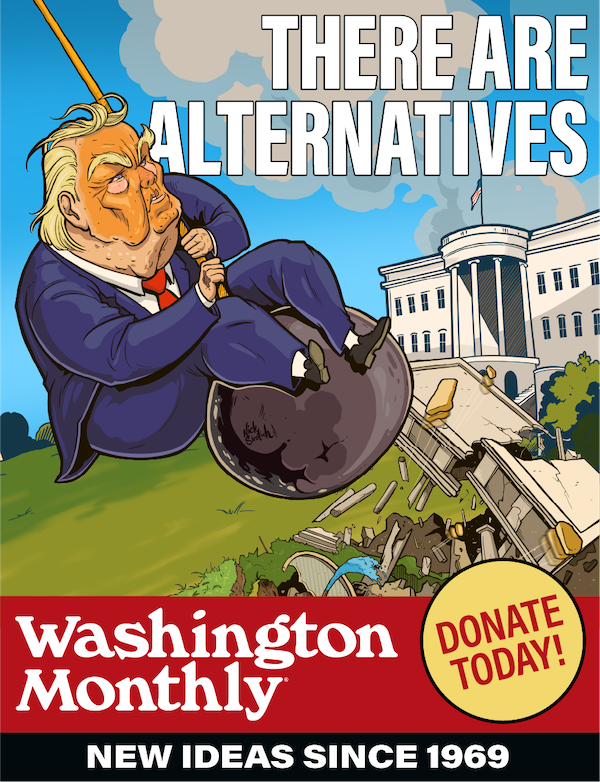
Donald Trump’s decision to start a war with Iran was stupid. It was unnecessary; Washington was in diplomatic talks with Tehran about its nuclear program when the president ordered the attack. It failed to eradicate Iran’s nuclear program, let alone its dictatorial regime. It cost America diplomatic leverage by allowing Iran to exert more control over the Strait of Hormuz, disrupt oil shipping, and inflate global fuel prices. It needlessly cost the lives of over 8000 people, including more than 5,000 civilians and 23 American soldiers. 23 American soldiers. Just about as stupid would be provoking a government shutdown in the name of ending the war with Iran.
With a December 11 deadline looming for Congress to pass legislation keeping the government open, Senator Chris Van Hollen, the Maryland Democrat, has made refusing to fund the war a rallying cry in his run for Senate Majority Leader.
Asked on MS NOW last Thursday “what’s the difference” between him and the current Senate Democratic leader Chuck Schumer, Van Hollen said, “The difference is I believe we need to be firm … We shouldn’t say we are going to wait until January when we have the power to do it on December 11 … Do it now. Not a penny, not a penny to fuel this war.”
(According to The New York Times, “Mr. Schumer and other top Democrats have been weighing a temporary extension of government funding with some restrictions on the military money until early 2027, when they would hold the majority and likely be able to exert more leverage against the Trump administration.”)
CNN’s Dana Bash noted that such a stance “could mean starting the Democratic majority next year with the government still shut down,” and asked, “would that be OK with you?” Van Hollen argued Trump would shoulder any blame: “The issue, Dana, is whether the President of the United States is going to tell the American people that he will shut down the federal government … to keep his illegal war with Iran going.”
Van Hollen may be correct that Democrats could both instigate the confrontation and pin the blame on Trump. This is what happened one year ago, when Democrats withheld votes to keep the government open until Republicans agreed to extend enhanced health insurance subsidies that were due to expire. Trump responded so cruelly—laying off federal employees and cutting off food aid to needy families—that he ended up owning the shutdown according to polls. After Republicans fared miserably in off-year elections, Trump openly admitted: “the shutdown was a big factor, negative for the Republicans.”
And yet, that admission did not lead to Trump coughing up policy concessions to the Democrats. Instead, eight Senate Democrats (including Angus King, the Maine independent who caucuses with the party) broke ranks and abandoned the Schumer-led filibuster. One of them, Illinois’s Dick Durbin, the outgoing Democratic whip, cited pleas from the American Federation of Government Employees union, whose members were taking the brunt of the shutdown: “They’re our friends; we take them seriously.”
I warned ahead of last year’s shutdown that “every past attempt to use government shutdowns to extract policy concessions has failed, even when the policy demands are politically popular” because “shutdowns make people forget what you have to say” as “public attention shifts to how shutdowns hurt average Americans.”
While shutdowns are always a tactical misfire, the timing for instigating a Democratic one next month couldn’t be worse. Van Hollen argued on MS NOW that the Senate should provide “not one more penny spent on this war so that we can bring [gas] prices down right away.” But the immediate result of a December 11 shutdown isn’t lower gas prices; it’s unpaid furloughs for thousands of federal employees two weeks before Christmas.
Moreover, gas prices are already edging down. As Yahoo! Finance reported Friday, that’s because “investors grew more optimistic about cooling tensions between the U.S. and Iran,” with major military operations over and, by mid-October, Persian Gulf oil exports actually outpacing pre-war amounts. Additionally, “seasonal factors may also be contributing to cheaper gas prices, as this time of year marks a shift from more expensive summer-blend fuel to cheaper winter-blend gasoline, along with reduced driving demand.” Democrats will have a hard time explaining to the public that they shut down the government and furloughed federal workers before Christmas because they believe such a sacrifice is necessary to lower gas prices, which are already falling.
Granted, the Middle East remains volatile. Iran has been launching drone attacks against Bahrain, which hosts an American naval base, claiming they are retaliation for a U.S. strike against an Iranian telecommunications tower. Three oil tankers hit mines in the Strait of Hormuz over the weekend. Peace talks are in limbo after Trump canceled plans for Vice President JD Vance to join negotiations. No one can assume gas prices will continue to ease—beyond those seasonal factors—when hostilities can flare up at any time, Iran still has effective control of the Strait of Hormuz, and the Iran-backed Houthis have control of the Bab al-Mandeb near Yemen.
But how would a shutdown standoff with Trump bring stability to the region and permanently lower gas prices? Even if Democrats could convince enough Republicans to pass a bill on their terms, Trump cannot be expected to sign anything that constrains his powers as Commander-in-Chief, nor can Republicans be expected to join Democrats in overriding a veto. Democrats have no endgame. As happened last year, a faction of Democrats would likely throw in the towel.
Even in a fantasy scenario in which a veto is overridden with 67 or more votes, a nominal cutoff of war funds would not, by itself, produce a peace agreement between Trump and the Iranian government that ensures a steady flow of oil. Trump would likely ignore any cutoff, deeming any such provision unconstitutional. The Supreme Court, with its fondness for the unitary executive theory, could well back him up.
Trump faces public ire for stubbornly continuing to wage an unpopular war, but that doesn’t mean the public would praise Democrats for trying really hard to stop it. If a shutdown grinds on for months, voters could easily become disgusted with both parties for playing political games. At the same time, federal workers go without pay (and I must stress again, including over the holiday season), government services are disrupted, and the economy suffers.
(The 2025 shutdown, which lasted six weeks, was estimated by J.P. Morgan economists to subtract each week “about 0.1% from annualized GDP growth.” GDP growth can rebound after a short shutdown; in last year’s disruption, according to the Federal Reserve, it largely did. But J.P. Morgan warned that with long shutdowns it can be “difficult to recoup all the lost activity in the following quarter.”)
After voters put their trust in them, Democrats no doubt feel pressure to move fast. But despite Congress’s power of the purse, Democrats can’t wrest from Trump the authority to conduct foreign policy and forge international agreements.
Congress does, however, have the power to set tariff rates and determine the scope of presidential tariff authority. Democrats are far more likely to deliver real results on affordability by focusing on passing bipartisan tariff reform than getting sucked into another shutdown morass.