It’s well established that the last decade has been unfriendly to friendship. We Americans in 2026 have fewer friends than we used to, spend less time talking with the ones we do have, and, depending on the survey, anywhere from 8 to 17 percent of our fellow citizens report having no close friends at all.
Even among those still maintaining human relationships, divisive events—say, a global pandemic, a disputed election, or overseas wars—have increasingly broken bonds. More than a third of Americans say they’ve ended a relationship—and most often, a friendship—over political difference.
It’s easy to see, then, why concerned parties would turn to the work of Hannah Arendt, the late political philosopher and leading theorist of how social isolation lays the groundwork for authoritarianism, who built and sustained friendships across chasms of disagreement. “What prepares men for totalitarian domination,” Arendt wrote in her oft-cited Origins of Totalitarianism, “is the fact that loneliness, once a borderline experience usually suffered in certain marginal social conditions like old age, has become an everyday experience of the evergrowing masses of our century.”
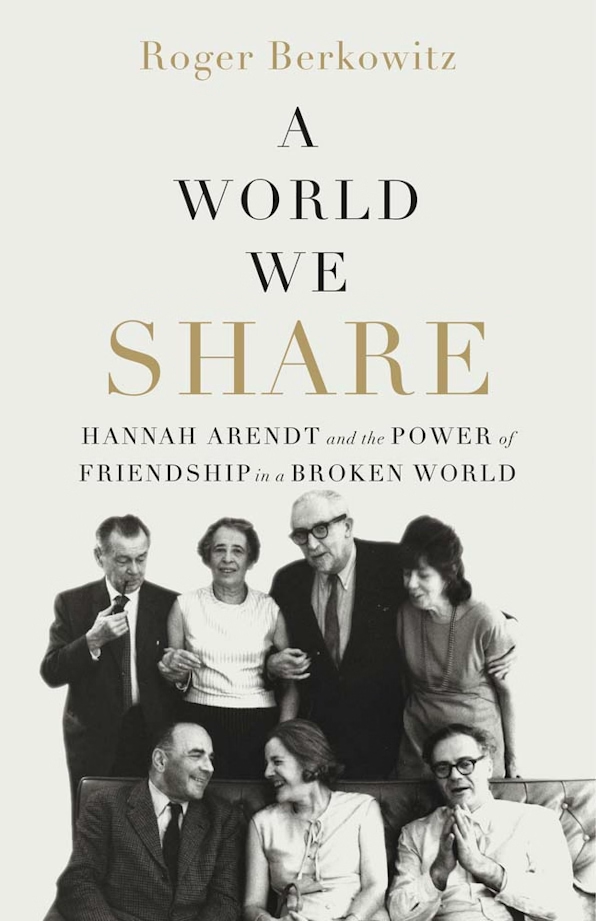
Despite living most of her life as a foreigner, first as a German refugee in Paris in the 1930s, then as a stateless refugee-turned-expat in New York City from 1941 until she died in 1975, friendlessness was foreign to Arendt. In his new book A World We Share: Hannah Arendt and the Power of Friendship in a Broken World, Roger Berkowitz, the founder and director of the Hannah Arendt Center for Politics and Humanities at Bard College, chronicles her many relationships as models of respectful disagreement.
Whereas couples in 2026 may bring arguments over Brexit or a vote for Donald Trump to their marriage counselors, Arendt, a German-Jewish academic, found a way to reconcile with Martin Heidegger, her former professor and lover who joined the Nazi Party and supported stripping Jewish professors of their positions. Cancellation, to put it mildly, was not her way.
Berkowitz attempts a heavy lift with A World We Share. Taking the parallel crises of politics and friendship as a starting point, and touching on the standoff between nationalist tribalism and cosmopolitan globalism along the way, he weaves toward a central argument: Claimed truths and moral certainties are fraying our political community; thus friendship, not truth, should form the basis of democratic life.
Berkowitz’s definition of friendship begins with the early medieval poem Beowulf, an early example of the Old English Freondum that introduced the word to the lexicon. When the knight Beowulf sits to feast in King Hrothgar’s hall, Berkowitz deduces that “friendship—in both word and idea—emerges around a table in spoken words.” With a University of California/Berkeley JD and PhD in philosophy, Berkowitz sees friendship in his circles as speaking and often disagreeing: “We may debate Hannah Arendt or Ayn Rand, weigh the merits of Billy Joel or Chopin, defend Barack Obama or Donald Trump.”
It was the same in Arendt’s: Whether with professors, lovers, or friends—all three being the same in the case of Heidegger—lofty argument marked her relationships.
Arendt’s second marriage to the self-taught philosopher Heinrich Blücher, for instance, was a contest of ideas. Blücher, a Berlin-born former Communist Party member, fled Nazi Germany for Paris, where he met Arendt in 1936. While she came from Germany’s academic elite, he grew up working-class and had no post-secondary credentials. Yet their different backgrounds seemed to feed the discourse that defined their household. To sit at their table was to take part in “the most passionate seminar I would ever witness between a man and a woman living together,” the literary critic Alfred Kazin wrote. And when the couple had the writer Randall Jarrell over, the men would apparently occupy themselves with “shouting matches over literature and poetry” whilst Arendt prepared dinner.
Ironically, the book’s most intriguing anecdotes show Arendt outside of arguments—both hers and Berkowitz’s. In his standalone chapter on Arendt’s female friendships, we see Hannah as girlfriend, confidant, and caretaker. For her friend Mary McCarthy, the American novelist, Arendt wrote to McCarthy’s third husband, helping to cover up his spouse’s extramarital tryst in London.
Through her relationship with Hilde Fränkel, another German expat, we see Arendt “captivated by Fränkel’s easy fluency with erotic passion,” inspired by her willingness to live “outside the expected boundaries of feminine propriety,” and open-minded about her friend’s “enormous collection of pornographic literature, which exclusively concerned sadomasochism and flagellation.”
“All men are baggage,” Fränkel once wrote to Arendt, complaining about her existentialist-theologian lover Paul Tillich with a postmarked rendition of today’s viral phrase “men are trash.”
And for Anne Weil, Arendt’s childhood friend who was entangled in a “horrific marriage,” Arendt arranged for gifts—coffee, Arendt’s own suit, and a new dress—to be sent from New York to Weil’s home in Paris. When Blücher died in 1970, and Arendt sank into sadness, their roles reversed: Anne traveled from Paris to New York, shopping for her friend, tending to the Upper West Side apartment, and speaking in their girlhood “East Prussian idioms” as Arendt grieved.
As a window into the near past, when relationships moved at the speed of letters and prominent thinkers all seemed to know one another, A World We Share is useful. Like Hemingway’s A Moveable Feast, it offers glimpses of public intellectuals living private lives: wandering arm in arm through streets reciting poetry, taking lovers, and carving out found families far from home.
But when we juxtapose their world with ours, the book’s functionality falters. Arendt’s relationships were unique, by both the standards of her day and modern metrics. Having a professor who becomes a lifelong friend is rare; having a sexual affair with that professor is rarer still; and having a husband who abides his wife’s reconciliation with her professor-turned-mentor-turned-lover even after that lover’s stint as a Nazi may be a singularly Arendt experience. That husband’s trajectory alone shows how different Arendt’s world was, as Blücher’s lack of higher education didn’t stop him from becoming a philosophy professor at Berkowitz’s own Bard College (which typically requires a PhD or equivalent credential for teaching positions today).
It’s hard to see how Arendt’s circle of expatriates, bohemians, and writers—highly educated, emphatically countercultural, cosmopolitan globalists to a tee—applies to our increasingly lonely and less literate America. Those sets of friends Berkowitz envisions debating Ayn Rand must be scarce, given the wide swath of us who didn’t read any book last year, much less the 1,100-plus pages of Atlas Shrugged. And that pair of men having a yell about prose over supper seem an uncommon couple even before Netflix, Twitch streams, and infinite scroll came to distract from both poetry and dinner tables.
The instances Berkowitz pulls from his own life, which frame the bulk of the book covering Arendt’s relationships, reveal the specific crises of friendship he’s really speaking to: disputes among university inhabitants.
In 2016, a letter accusing Berkowitz of platforming fascism by inviting the German philosopher Marc Jonogen, now a member of the European Parliament for the populist, anti-immigrant Alternative for Germany, or AfD, to speak at a conference was signed by 56 political theorists at universities in Europe and the United States. A colleague called to warn him: She’d signed the letter. She hoped they could still be friends. Berkowitz was “astonished.” “If you disagreed with me, you could have called me before you signed a public letter against me,” he told her.
The most similar experience Arendt had to Berkowitz’s scholarly shaming came after the publication of her 1963 book Eichmann in Jerusalem: A Report on the Banality of Evil, which covered the trial of Adolf Eichmann, a Nazi responsible for organizing the deportation of millions of Jews to extermination camps. Some Jewish leaders, including friends of Arendt’s, took her quest to understand Eichmann’s motivations—she concludes that he was driven by thoughtlessness, career ambition, and conformity rather than exceptional monstrosity—as excusing his atrocities. Reviews termed her a “self-hating Jew and Nazi lover.”
Berkowitz gives this “feeding frenzy” and Arendt’s efforts to mend her ruptured relations its own chapter, the takeaway being that “friendship requires that we do not put people in a box, reduce them to labels like ‘Zionist’ or ‘Anti-Zionist,’ and that we elevate respect for our friends above the question of whether we think their opinions are correct.”
This lesson is especially relevant to Berkowitz. In 2023, another faculty letter made the rounds at Bard—this one, calling for solidarity with Palestinians yet making no mention of the slaughter of Israeli civilians less than two weeks after Hamas’s October 7 attacks. “I recognized many of the names on the letter—colleagues I respect, some I consider friends, even people who have sat at my dinner table,” Berkowitz writes. “Reading those names was like receiving a body blow.”
Bard College was among the campuses that saw pro-Palestinian encampments in 2024. As an analysis by this magazine showed, those schools were, overall, elite institutions with fewer working-class students. And that is what A World We Share lacks: some semblance of class consciousness. While Berkowitz poses many interesting questions about friendship—“can a thoughtful and caring person be friends with Stephen Miller, the architect of Donald Trump’s cruel and brutal deportation regime?”—he spares no words for the loneliest Americans, who are disproportionately not on college campuses at all.
In 2024, nearly a quarter of U.S. adults with a high school diploma or lower reported having no close friends, compared to just 10 percent of college-educated adults who said the same. Those with lower education levels also follow local news more than national or international news, are less politically engaged, and are more likely to have voted Donald Trump back into the White House. Yet that working-class Americans are lonelier at higher rates—or that this group has disproportionately supported a president flirting with authoritarianism, exactly as Arendt’s Origins might expect—goes entirely unaddressed.
Berkowitz’s answer to today’s crises of politics and friendship is simple and rosy: keep sitting and talking with one another. “As long as the table is there, we are connected, even amid our differences,” he writes. “We pass the salad we made together with grilled peaches; we enjoy the avocado with chili pepper. We marvel at the freshness of the corn and the perfectly cooked salmon and steak grilled on a Himalayan salt block.”
What he fails to mention is that the primary fault line in today’s politics isn’t what we’re arguing about at the dinner table so much as what we can afford to put on it, and that for most Americans, Himalayan-salt-block steak is rarely on the menu.